


From traditional Chinese medicine to modern medicine: the multifaceted charm of 4-hydroxybenzyl alcohol
Jun 24,2026
Introduction
Insomnia, stroke, tumors—these major health problems that plague modern people may be able to find new solutions from ancient Chinese medicine. Gastrodia elata has long been recorded in the Chinese Pharmacopoeia and is used to treat neurological diseases such as headache, dizziness, and epilepsy [1]. One of the core active ingredients of Gastrodia elata, 4-Hydroxybenzyl alcohol (4-HBA for short), is gradually becoming a hot spot in modern drug research. Modern pharmacological experiments have confirmed that 4-Hydroxybenzyl alcohol has various effects such as regulating the central nervous system, antioxidant, and anti-inflammatory [1][3].

Multifaceted pharmacological activities
Sedation and hypnosis: new hope in the fight against insomnia
Sleep disorders affect nearly half of the world's population. Research has found that 4-Hydroxybenzyl alcohol itself has a sedative effect, and the derivative obtained through structural modification—**4-hydroxybenzyl alcohol-3-furancarboxylic acid diester (2FHBA)**—exhibits more excellent sedative-hypnotic activity [1]. In animal experiments, 2FHBA (10 mg/kg) can significantly shorten sleep latency and extend sleep time. Mechanism research shows that its effect is closely related to the **5-hydroxytryptaminergic system** and **GABAergic system** [1]. More importantly, acute toxicity experiments showed that 2FHBA did not cause death in mice at doses as high as 5000 mg/kg, showing good safety [1].
Antioxidants and Neuroprotection: Guardians of the Brain
In cerebral ischemia-reperfusion injury, oxidative stress is the key driver of neuronal death. 4-Hydroxybenzyl alcohol can significantly reduce cerebral infarction volume and improve neurological deficits [5]. One of its mechanisms is to upregulate the expression of endogenous antioxidant enzyme **NQO1** [5]. In astrocytes, 4-Hydroxybenzyl alcohol induces the expression of a series of antioxidant genes such as HO-1, NQO1, and GCLM** by activating the Nrf2 signaling pathway [4]. Surprisingly, astrocytes treated with 4-Hydroxybenzyl alcohol can also secrete neurotrophic factors such as **GDNF** and **VEGF** to protect surrounding neurons in a paracrine manner - this "altruistic" protection mechanism is particularly valuable in neuroprotective strategies [4].
Anti-tumor angiogenesis: cutting off the nutrient supply to tumors
The growth of tumors cannot be separated from the nutritional support of new blood vessels. 4-Hydroxybenzyl alcohol4-HBA can dose-dependently inhibit angiogenesis on the chorioallantoic membrane (CAM) of chick embryos [3]. In colon cancer models, 4-Hydroxybenzyl alcohol (200 mg/kg) treatment reduced the functional capillary density of tumors by approximately 50% and significantly inhibited tumor growth [2]. In vitro experiments show that 4-Hydroxybenzyl alcohol can reduce the viability of tumor cells, destroy the cytoskeleton, and inhibit migration and invasion [2]. As a multi-target anti-angiogenic agent, 4-Hydroxybenzyl alcohol may have advantages over single-target drugs and is less likely to develop drug resistance [2].
Anti-inflammatory and analgesic
4-Hydroxybenzyl alcohol also has anti-inflammatory and analgesic activities. In the carrageenan-induced rat air sac model, 4-Hydroxybenzyl alcohol can reduce inflammatory exudate volume and leukocyte infiltration [3]. In the acetic acid-induced writhing experiment in mice, 4-Hydroxybenzyl alcohol (100 mg/kg) reduced the number of writhings by 44% [3]. Mechanistically, 4-Hydroxybenzyl alcohol can inhibit lipopolysaccharide (LPS)-induced **iNOS** expression and **NO** production in macrophages [3].
Synthesis method
Researchers have synthesized a variety of derivatives through the esterification reaction of 4-Hydroxybenzyl alcohol with various carboxylic acids [1]. Taking 2FHBA as an example: Dissolve 3-furancarboxylic acid (6 mmol) and EDCI (8 mmol) in dichloromethane, add 4-Hydroxybenzyl alcohol (4 mmol) and DMAP (4.8 mmol), reflux at 60°C for 6 hours, and purify through silica gel column chromatography (petroleum ether/acetone = 6:1) to obtain the target product [1]. Nine other ester derivatives were synthesized through similar methods, with yields ranging from 35% to 93% [1].
Detection method
Structural identification mainly relies on a variety of spectroscopic techniques [1]:
IR spectrum: The C=O stretching vibration peak of the ester bond appears at 1730–1765 cm⁻¹, and the disappearance or weakening of the phenolic hydroxyl peak (about 3400 cm⁻¹) indicates the success of esterification.
NMR spectrum: The disappearance of δ 5.0–6.0 (alcoholic hydroxyl hydrogen) and δ 9.0–9.5 (phenolic hydroxyl hydrogen) signals in ¹H NMR confirms that both hydroxyl groups are esterified; the ester carbonyl signal at δ 165–175 ppm in ¹³C NMR further confirms.
HRMS: Accurate molecular weight determination (e.g. 2FHBA measured [M+H]⁺ 312.0639, theoretical 312.0634) confirms the target compound [1].
Biological activity evaluation uses classic behavioral pharmacology methods such as spontaneous activity experiments and pentobarbital-induced sleep experiments [1].
Attention
Although 4-Hydroxybenzyl alcohol has shown good safety in animal experiments (LD₅₀ > 5000 mg/kg) [1][2], current research is still mainly in the preclinical stage. Key issues such as pharmacokinetics, long-term safety, and effective dosage in humans have yet to be elucidated [2]. In addition, some activities of 4-Hydroxybenzyl alcohol require higher concentrations (such as the mM level used in in vitro experiments) [4]. How to improve its bioavailability through structural optimization or formulation technology is an important direction for future research. At the same time, the toxicological evaluation of long-term medication also needs to be improved [2].
Conclusion
From an active ingredient in ancient Chinese medicine to an all-rounder in sedation, hypnosis, neuroprotection, and anti-tumor angiogenesis, 4-Hydroxybenzyl alcohol demonstrates the great potential of natural products as drug lead compounds. As the researchers said: “Natural products have become an important source of biologically active lead compounds, especially derivatives obtained through synthetic transformation or structural modification, which have occupied a leading position in recent years” [1].
References
[1]Zhu, H. Y., Zhang, D., Zhang, Q., et al. (2018). 4-Hydroxybenzyl alcohol derivatives and their sedative–hypnotic activities. RSC Advances, 8, 19539–19547.
[2]Laschke, M. W., Vorsterman van Oijen, A. E., K?rbel, C., et al. (2013). 4-Hydroxybenzyl alcohol: A novel inhibitor of tumor angiogenesis and growth. Life Sciences, 93(1), 44–50.
[3]Lim, E. J., Kang, H. J., Jung, H. J., et al. (2007). Anti-angiogenic, anti-inflammatory and anti-nociceptive activity of 4-hydroxybenzyl alcohol. Journal of Pharmacy and Pharmacology, 59, 1235–1240.
[4]Luo, L., Kim, S. W., Lee, H. K., et al. (2017). Anti-oxidative effects of 4-hydroxybenzyl alcohol in astrocytes confer protective effects in autocrine and paracrine manners. PLOS ONE, 12(5), e0177322.
[5]Yu, S. S., Zhao, J., Lei, S. P., et al. (2011). 4-Hydroxybenzyl alcohol ameliorates cerebral injury in rats by antioxidant action. Neurochemical Research, 36, 339–346.
- Related articles
- Related Qustion

This report covers benzenesulfonyl chloride synthesis, its Pd-catalyzed arylation and g?C?N? photocatalysis applications.....
Jun 24,2026Organic Synthesis Intermediate
Trimethylborate is a colorless, transparent and flammable liquid and is the basis of the entire borohydride industry chain.....
Jun 24,2026API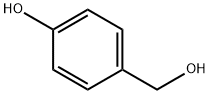
4-Hydroxybenzyl alcohol
623-05-2You may like
4-Hydroxybenzyl alcohol manufacturers
- 4-Hydroxybenzyl alcohol
-
- 2026-06-25
- CAS:623-05-2
- Min. Order: 5KG
- Purity: 99%min
- Supply Ability: 15tons/month
- 4-Hydroxybenzyl alcohol
-

- $29.00
- 2026-06-09
- CAS:623-05-2
- Purity: 98.37%
- Supply Ability: 10g
- 4-Hydroxybenzyl Alcohol
-

- $9.00
- 2026-05-28
- CAS:623-05-2
- Min. Order: 1ASSAYS
- Purity: 99%
- Supply Ability: 10000kg